Wednesday, 24 January 2018

Read about a newly discovered bacterium that could be a source of antibiotics on Scroll.in, The Hindu Bussiness Line, and Down to Earth
Friday, 4 August 2017
Scientists find a way to precisely identify pests to minimize agricultural losses
DNA barcoding is a technique that uses gene sequence
information for identifying organisms. Now scientists have deployed this technique
to identify thrips insect species in India and found that this technique is
effective.
The study is important
for the agricultural sector as thrips cause huge losses to crops such as onion,
chilli, brinjal, capsicum, watermelon and tomato. Identifying thrips correctly
can help design relevant pest management strategies to prevent these losses.
Thrips also leave white streaky trails after feeding on fruits that makes them unfit for exports. In the long run, using DNA barcoding for identifying thrips could help increase income from exports, believes Dr. Vikas Kumar, who is a lead author on this study.
Thrips are minute plant
sucking insects, one to three millimeters in length that cause damage to crops by
direct feeding and by transmitting plant viruses. To date, these insects are identified
based on their physical features like color and body architecture. The major
obstacle in correct identification is their small size and high degree of
similarity at some stages of their life cycle. Identifying these insects
correctly is important for designing appropriate pest management strategies.
Researchers at the
Centre for DNA Taxonomy, Zoological Survey of India in Kolkata tested DNA
barcoding technique for precise identification of thrips insects. They
collected 336 insect samples from 78 locations in India. The sample collection was
done for 4 years between 2011 and 2015. In 3 years time, they have made a
library of 370 DNA sequences that can be used for precisely identifying these
plant pests. The results were published in a recent issue of the journal Scientific Reports.
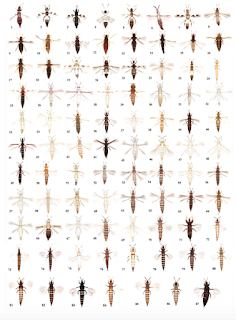
Kaomud Tyagi, who is the first author on the study, classified the collected samples into 89 species based on their physical features. “But information of physical features is not enough to identify species”, she says.
So they did a further
DNA analysis to analyze the sequence of the mitochondrial cytochrome oxidase
gene.
“We have standardized and confirmed DNA barcoding method to be used for identifying thrips species correctly. Our study has also revealed that similar looking insects can belong to different species. Identifying species of thrips is now possible at the larval stage or even from a small portion of the body”, Dr. Kumar told India Science Wire.
It will help design appropriate intervention for
pest management as different species respond to different pesticides and doses.
Most of the species included in this study are serious pests on a wide variety
of agricultural and horticultural crops, he adds.
Sharad Mohan, Scientist at the Indian Agricultural Research Institute, New Delhi, who is not connected to the study agrees that, “bar coding is of immense value in validating the diversity of pests in different agro-climatic zone of India. Instead of using conventional taxonomic ways that may take months, barcoding helps in identifying pests that helps recommend and implement specific management protocols without wasting much time”, he says.
The study was done
by Kaomud Tyagi, Vikas Kumar, Devkant Singha, Kailash Chandra, Boni Amin
Laskar, Shantanu Kundu, Rajasree Chakraborty, and Sumantika Chatterjee. It was
funded by the Zoological Survey of India (ZSI), Kolkata.
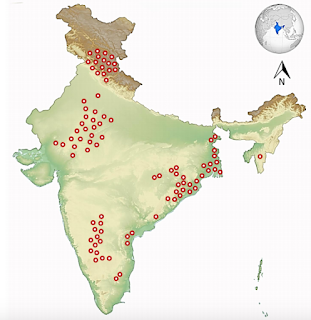

The samples were collected from different parts of India indicated in red.

The different species of Thrips classified based on physical features.
Kailash Chandra, who is the Director of ZSI and an author on the paper said, “We are starting a new project on large scale barcoding insect pests and vectors of agricultural and veterinary importance soon”.Reference: Scientific Reports | 7: 4898 | DOI: 10.1038/s41598-017-05112-7
This story was published by IndiaBioScience, India Science Wire, NetIndian, The Hindu (clip below), and BioVoice.

Monday, 24 July 2017
Many retail foods are teemed with antibiotic-resistant bacteria, study finds
Some of our daily foods are loaded with antibiotic-resistant bacteria,
a new study has pointed out.
“We have isolated multiple antibiotic-resistant bacteria from chicken and mung sprout samples, which can have serious health concerns”, says Archana Rath, professor at the University of Mumbai and the lead author of the study.
Her team collected fourteen
samples of raw chicken from retail poultry shops and thirteen ready-to-eat
sprouted mung bean samples from local street vendors of Mumbai. Chicken samples
were procured within 2-3 hours of slaughter and sprouted mung beans were less
than 72 hours post sprout. Using standard lab methods, scientists isolated
bacteria from these food samples and tested them for their sensitivity to
various antibiotics. They found that many food-derived bacteria were resistant
to one or more clinically used antibiotics- penicillin, rifampicin, streptomycin,
ciprofloxacin, chloramphenicol, cefotaxime, erythromycin, kanamycin, gentamicin,
doxycycline, neomycin, and trimethoprim.
“Abundance of opportunistic pathogens like Acinetobacter, Enterobacter, Klebsiella in mung, and Acinetobacter, Enterococcus, Serratia, Providencia in chicken could be a serious health issue. Acinetobacter is a clinical pathogen known to carry genes for antimicrobial resistance”, they say.
The
study was published in the July issue of the journal Current Science.
According to the authors, most
of the bacteria in the mung were similar to those found in wastewater treatment
plants and manure treated agro ecosystems, which suggested that manure-treated
soil or contaminated irrigation water are the potential sources of pathogens in
mung. With chicken, they say, the high numbers of resistant bacteria could be
because of the rampant use of antibiotics as a veterinary therapy in livestock
industry and farms.
Dr. Rath told India Science Wire, “sprouted mung is generally consumed raw hence the presence of resistant bacteria in it is a matter of concern. Although chicken is cooked before consumption that kills microbes, it can still spread antibiotic resistant bacteria to raw salads or veggies in the vicinity especially in fast food joints and restaurants where hygiene may not always be maintained”, she says.
She
stressed that similar studies need to be done on other food types to ascertain
their antibiotic resistance load and quality.
This study was done by Onkar
Naik, Ravindranath Shashidhar, Devashish Rath, Jayant Bandekar, and Archana
Rath at the University of Mumbai and Food technology division and Molecular
Biology Division of the Bhabha Atomic Research Center, Mumbai. The work was
supported by the Department of Atomic Energy-Board of Research in Nuclear Sciences.
This story was published by Scroll, India Science Wire, Indian Science Journal, Newsroom24X7, Outlook India, and BiotechTimes.
Tuesday, 13 June 2017
Temperatures in India are rising, which could mean more deaths due to heat waves, say scientists at IIT-Delhi and Bombay
A recent study
has found that the mean temperatures in India have risen by 0.5 degree Celsius
over a period of 60 years, which corresponds to a 146% increase in the
probability of deaths due to heat waves in the country. Done by researchers at
the Indian Institute of Technology (IIT)-Delhi and IIT-Bombay, Mumbai, and University of California, Irvine and Los Angeles, and Boise
State University, USA, it deciphers that even moderate increases in mean temperatures, such as 0.5°C, may lead to
large increases in heat wave-related deaths. Based on their findings, they urge
the government to put in more efforts to build up the resilience of vulnerable
populations in regions with severe heat waves.
They studied temperature data from 395 weather stations
from Indian meteorological department between the years 1960 to 2009. “Our
results suggest that future climate warming will lead to substantial increases
in heat-related deaths, particularly in developing low-latitude countries, such
as India, where heat waves will become more frequent and populations are
especially vulnerable to these extreme temperatures” they say. The research
team comprised of Omid Mazdiyasni, Amir
AghaKouchak, Steven J Davis, Shahrbanou Madadgar, Ali Mehran, Elisa Ragno, Mojtaba
Sadegh, Ashmita Sengupta, Subimal Ghosh, CT Dhanya, and Mohsen Niknejad. They
published their results in the journal Science Advances. .
Their data shows that in years—1972,
1988, 1998, and 2003—when there were more than 10 heat wave days on average
across India, there was a corresponding spike in heat-related deaths of between
650 and 1500 people.
The substantial increase in
mortality rates due to 0.5°C increase in summer mean temperature or two more
heat wave days suggests that future climate warming could have a relatively
drastic human toll in India and similarly in developing tropical and
subtropical countries. “Our data will create awareness about the impact of
rising temperatures in India on health, and this needs to be urgently
communicated to the society”, says Dr. Subimal Ghosh, at the Department of
Civil engineering at IIT-Bombay in Mumbai, who did the study.
Reference: Science Advances 3: e1700066.
This story got published in Down To Earth, BioVoice, CatchNews, Newsroom24X7, and Dainik Jagran.

Friday, 9 June 2017
Indian scientists find 5g to kill leukemia
Indian scientists have found a new compound that effectively
kills leukemic cancer cells. Named 5g,
it kills more than 70 percent leukemic cancer cells in culture in 48 hours time
at an extremely low concentration of 50 micromolar. It did not affect blood
cells from healthy individuals, which signifies that it shows a higher toxicity
to cancer cells. “After treating cancer cells, they either entered cell death or
reverted back to normal cell cycle”, say scientists who tested this new
compound.
This effect of 5g was most
prominent on leukemic cells, while some cancer cell lines like colorectal and cervical
cancer cell line showed less effect, which implies that this drug is of
particular relevance in treating leukemia. The new compound accumulates
death-inducing reactive oxygen species in cancer cells leading to breaks in
DNA, which ultimately causes cell death. “We are working with Mysuru University
to improve its efficacy. We believe that it has the potential to be developed
as an anti-leukemic agent”, says Professor Sathees Raghavan, at the Indian
Institute of Science, Bangalore.
Daily doses of 5g for 2 weeks reduced the size of tumor
in mice. It was nontoxic and moderately increased the life span of tumorigenic
mice. The tumor regression was incomplete, because of which, the scientists
suggest that 5g needs combinational compounds to increase its efficiency. “We
identify a novel inhibitor of cell cycle and provide evidence at proof of
principle level that 5g can be
developed as a potent anticancer molecule for chemotherapy”, they say.
This study was done at the Indian
Institute of Science in Bangalore, University of Mysore in Mysuru, and Institute
of Bioinformatics and Applied Biotechnology in Bangalore. It was supported by
IISc-Department of Biotechnology partnership. The research team consisted of Mahesh
Hegde, Supriya V Vartak, Chandagirikoppal V Kavitha, Hanumappa Ananda, Doddakunche
S Prasanna, Vidya Gopalakrishnan, Bibha Choudhary, Kanchugarakoppal, S
Rangappa, and Sathees C Raghavan.
This story was published by Down To Earth, OutlookIndia, Newsroom24X7, BioVoice, Amar Ujala, Dainik Jagran, and India Science Wire.

This news appeared in Amar Ujala.

This news appeared in Dainik Jagran.

Dr. Sathees Raghavan from IISc, Bangalore, with his student Supriya Vartak, who are co-authors of the study.
Reference: Scientific Reports 7: 2533.
Wednesday, 7 June 2017
TB vaccination programs and deworming need to go together, say scientists
There is an immediate need to combine deworming and TB
vaccination programs, according to a report by researchers from India and USA
that appeared in a recent issue of the journal PLOS Neglected Tropical Diseases. They studied latent TB patients who
are infected with the disease-causing bacterium but cannot spread it to others
because the infection is kept under control by the immune system of the body.
Some of these latent TB patients were also infected with the threadworm Strongyloides stercoralis. This worm
survives in the small intestine of many organisms including humans, cats, dogs,
and non-human primates like chimps. It spreads through feces contaminated soil common
in rural areas from developing countries where sanitation standards are poor.
They studied a total of 132
individuals in Tamil Nadu, with 44 people in each of the three groups- those with
latent TB, threadworm infestation, and with latent TB and worm infection both. They
found that latent TB patients with worm infestation had lower numbers of immune
cells called B-cells that secrete antibodies that keep TB under check. In
addition to lowered B-cell numbers, they had reduced levels of antibodies
against TB in their blood that signifies a weak immune response against TB in
their body. When these patients were treated with deworming drugs ivermectin or
albendazole, the immune cells and antibody levels recovered.
“The implications of our
study are twofold: threadworms might promote reactivation of active TB in
latent TB infected patients, and also negatively influence the immune response
to TB vaccines. We suggest that treatment for worm infection would make for a prudent
first step in the conduct of TB vaccine trials in countries endemic for both TB
and worms”, says Professor Subash Babu, Scientific
Director at the National Institute of Research in Tuberculosis, formerly
Tuberculosis Research Center in Chennai.
The research team comprised
of Rajamanickam Anuradha, Saravanan Munisankar, Yukti Bhootra, Chandrakumar
Dolla, Paul Kumaran, Thomas B Nutman, and Subash Babu. The study was done at
the National Institute for Research in Tuberculosis in Chennai and National Institutes
of Health, Bethesda in USA.


This news was published by Newsroom24X7, BioVoice, and India Science Wire.
Reference: PLOS Neglected Tropical Diseases 11 (5): e0005569.
Subscribe to:
Posts (Atom)